
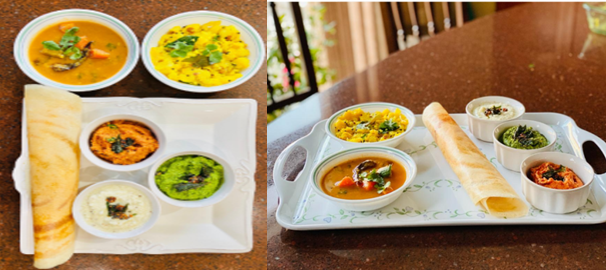
Dosa is one of the most classic breakfast dishes found across every South Indian homes. This is also one of the most ancient breakfast dishes and is even mentioned in the 1st century Tamil Sangam literature. The dosa recipes underwent changes through the course of time and a recipe that is very similar to the modern dosa was found in Karnataka around 12th century. The crispy fried dosas found in modern restaurants today was popularized by Udupi restaurants. This recipe spread like wild fire and travelled to other parts of India and soon became a favorite among North Indians and people across the world. The ingredients of dosa vary from home to home and every grandmother has a version of this specialty. The modern dosa batter is prepared from fermented urad dal and rice batter, flavored with fenugreek seeds and cooked in ghee or oil. The Masala, a spicy potato and onion mixture, was later introduced by Udupi people, elevating the dosa to another level. Dosa is often served with coconut chutney and sambar, which is a spicy and sour lentil and vegetable stew invented by Maharashtrians. No matter who you are, you will not be able to resist the taste or the texture, be it soft, thick dosa or crispy, paper thin dosas. Dosa, along with sambar and coconut chutney is a complete meal, so these days it is served not only for breakfast, but also for lunch or dinner.
Details
50 dosas <br>(on a 10 inch griddle)
60 minutes
5 minutes per dosa
182 calories per dosa
 Print
Print
Ingredients
Raw Rice 500 gms
Whole Urad Dal (skinless) 100 gms
Chana Dal 50 gms
Methi seeds 10 gms
Sugar 1 tsp
Salt to taste
Indian Sesame oil or Ghee 60 tsps (can be substituted with any other neutral oil)
Directions
- Wash the raw rice, urad dal and chana dal 3-4 times or until the water becomes clear.
- Soak everything together along with the methi seeds for 5-6 hours and grind into a coarse batter in a wet grinder. If you are using a blender or mixer grinder, grind in small batches.
- Cover and keep overnight for fermentation.
- Before preparing dosa, add the sugar and salt to taste and mix the batter thoroughly. The consistency of the batter should be of pouring consistency. If it is too thick, add some water and mix again.
- Heat the griddle and season the hot griddle by adding a few drops of oil to the griddle and spread it well over the surface. Make sure there is no excess oil on the griddle.
- On a medium high heat, sprinkle a few drops of water to test if the griddle is heated up. If the water sizzles immediately, the griddle is ready.
- Stir the batter and pour 90-100ml of batter to the centre of the pan.
- Immediately, spread the batter in a clockwise motion starting from the centre to the edges of the pan.
- Add ghee or oil to the dosa as well as around the edges of the dosa , turn the heat to medium high and cook for a couple of minutes.
- When the bottom side starts turning caramel, slowly release the dosa from the pan using a spatula.
- Eat it as it is or fold it into a triangle or cone or roll it into a cylindrical shape.
- Serve hot with sambar and chutneys.
Chef’s Twist :-
Use 250 gms raw rice and 250 gms multi grain rice mix that is readily available in the market to make the dosa batter.
When dosa is well done on one side, flip it and cook for 30 seconds (if you prefer both sides to be cooked).
Use half the batter and spread it into a thick and smaller circle, pour oil on the batter and around the sides of the dosa, top with onion, green chillies, coriander leaves, tomatoes, grated carrots, grated ginger (any of the toppings or a combination) and cook for 3 minutes on medium low and voila, your oothappam is ready!